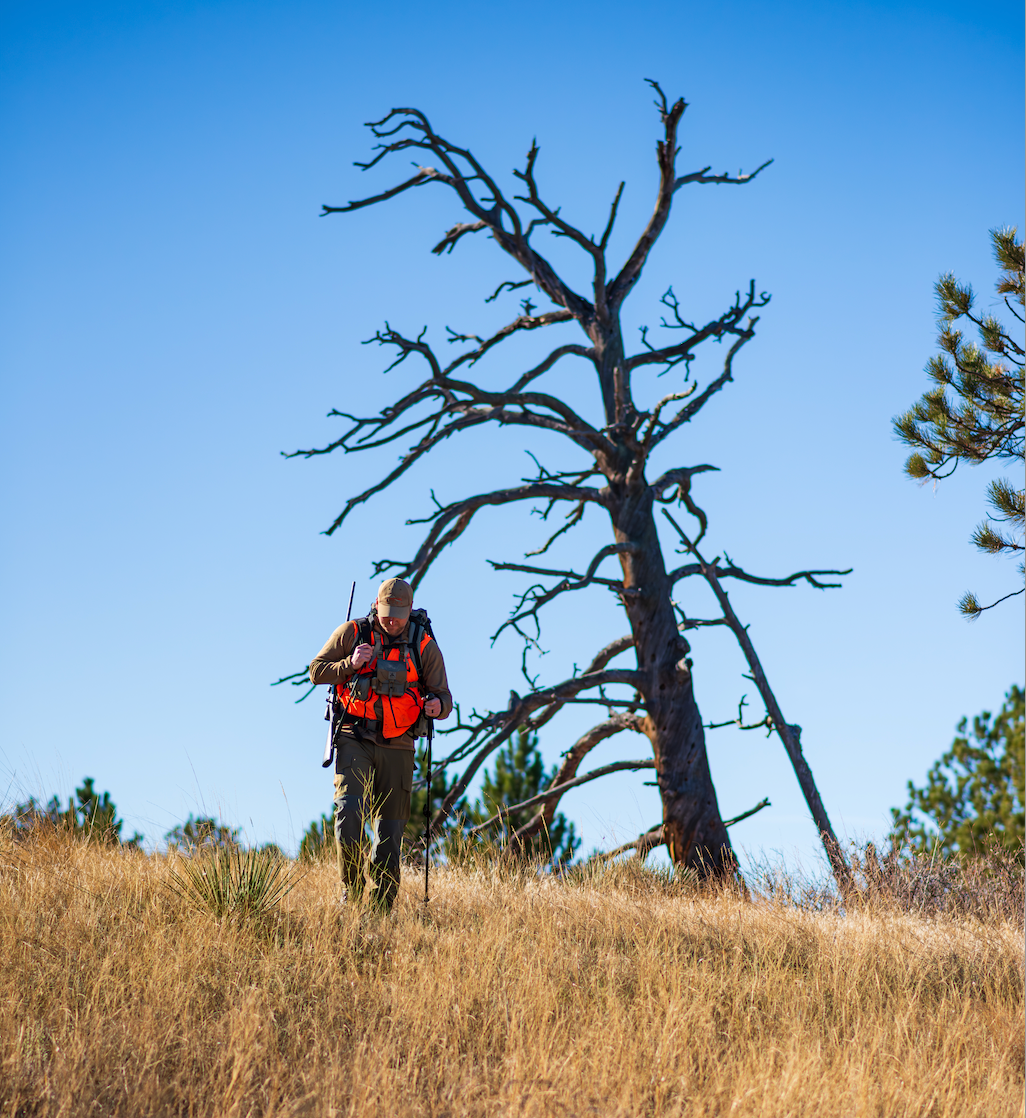
Tripods have become a serious piece of kit in the backcountry hunting community, and for good reason. A quality tripod with a fluid head is one of the best tools available for extended glassing sessions and long-range shooting support. If you're camped on a ridge glassing a basin for hours, or dialing in a precision shot at extended distance, a tripod earns its place in the pack.
But backcountry hunting isn't only about glassing basins and long-range shots. It's also about covering miles of steep, technical terrain, reacting quickly when an animal appears at an unexpected range, and keeping your pack light enough to still be functional at the end of day four. That's where the comparison between a tripod and the RoadRunner Rifle Rest gets interesting.
The Weight Reality
Even the most weight-conscious hunters face a real penalty with a tripod. The lightest ultralight hunting tripods on the market — carbon fiber options from brands like MTN HNTR and Aziak — come in around 21 ounces for the legs alone. Add a quality fluid or pan head, and you're looking at 28–32 ounces minimum for a functional setup. Full-featured hunting tripods from brands like Outdoorsmans run considerably heavier, in the 3–5 pound range, which is a serious pack weight commitment.
The RoadRunner Rifle Rest weighs just over one ounce and mounts to the trekking pole you're already carrying.
For a base camp or glassing-focused hunt where the tripod lives on a ridge and you're not moving much, that weight difference is manageable. For a mobile backcountry hunt where you're covering miles daily with a full pack, the math changes fast.
Setup Time and Mobility
A tripod needs to be deployed, leveled, and positioned every time you stop. On a dedicated glassing session, that's fine — you're setting up intentionally and staying put. But in mountain hunting, opportunities rarely announce themselves with enough warning to unpack and set up a tripod before the window closes.
An elk stepping into a meadow, a mule deer cresting a ridge, an antelope moving through a saddle — these are often seconds-long opportunities on moving animals. The RoadRunner deploys in one motion from the pole already in your hand. You don't dig anything out of your pack. There's no leveling, no leg adjustment, no head to position. Plant, pivot, shoot.
For shots that happen fast in dynamic terrain, that speed difference is the difference between a shot taken and a shot missed.
Terrain Versatility
Tripods work best on relatively level, stable ground where all three legs can be planted evenly. On steep sidehills, loose rock, or uneven terrain — the kind of ground that defines most mountain hunting — getting a tripod level and stable takes time and adjustment, and it doesn't always work cleanly.
The RoadRunner works wherever your trekking pole works. Steep sidehill? Plant the pole into the slope and lean in. Loose ground? Find solid footing for the pole tip and build your position around it. The single-point contact of a well-planted pole adapts to terrain that would frustrate a three-legged setup.
Where the Tripod Wins
None of this means a tripod doesn't have a place. For serious long-range shooting where stability over a heavy, magnified rifle at extended distances is the priority, a quality tripod with a stable head is hard to beat. For backcountry glassing sessions where you're parked in one spot for hours working a drainage, a tripod lets you run your spotting scope with the kind of rock-solid stability that a trekking pole rest can't fully replicate at high magnification.
Hunters running dedicated long-range setups, sheep hunters glassing for days from a fixed glassing point, or anyone where the hunt style is "find the spot, glass hard, make one shot count at distance" — a quality tripod makes a strong case.
The Mountain Hunting Reality
For the mobile mountain hunter covering real terrain in pursuit of elk, mule deer, or backcountry antelope, the RoadRunner is the more practical tool in most situations. It adds an ounce to your existing kit, deploys instantly, adapts to any terrain, and keeps your rifle handling exactly as it was designed to. It's not trying to replace the tripod for every use case — just the ones that matter most when you're actually in the mountains and the hunt is on.
If weight and mobility are priorities and your shots are happening in the 50–300 yard range across real mountain terrain, the RoadRunner is the right tool. If you're glassing for days and making long shots from a fixed position, bring the tripod. Many serious mountain hunters end up doing both — running a tripod for glassing and the RoadRunner when it's time to move and hunt.