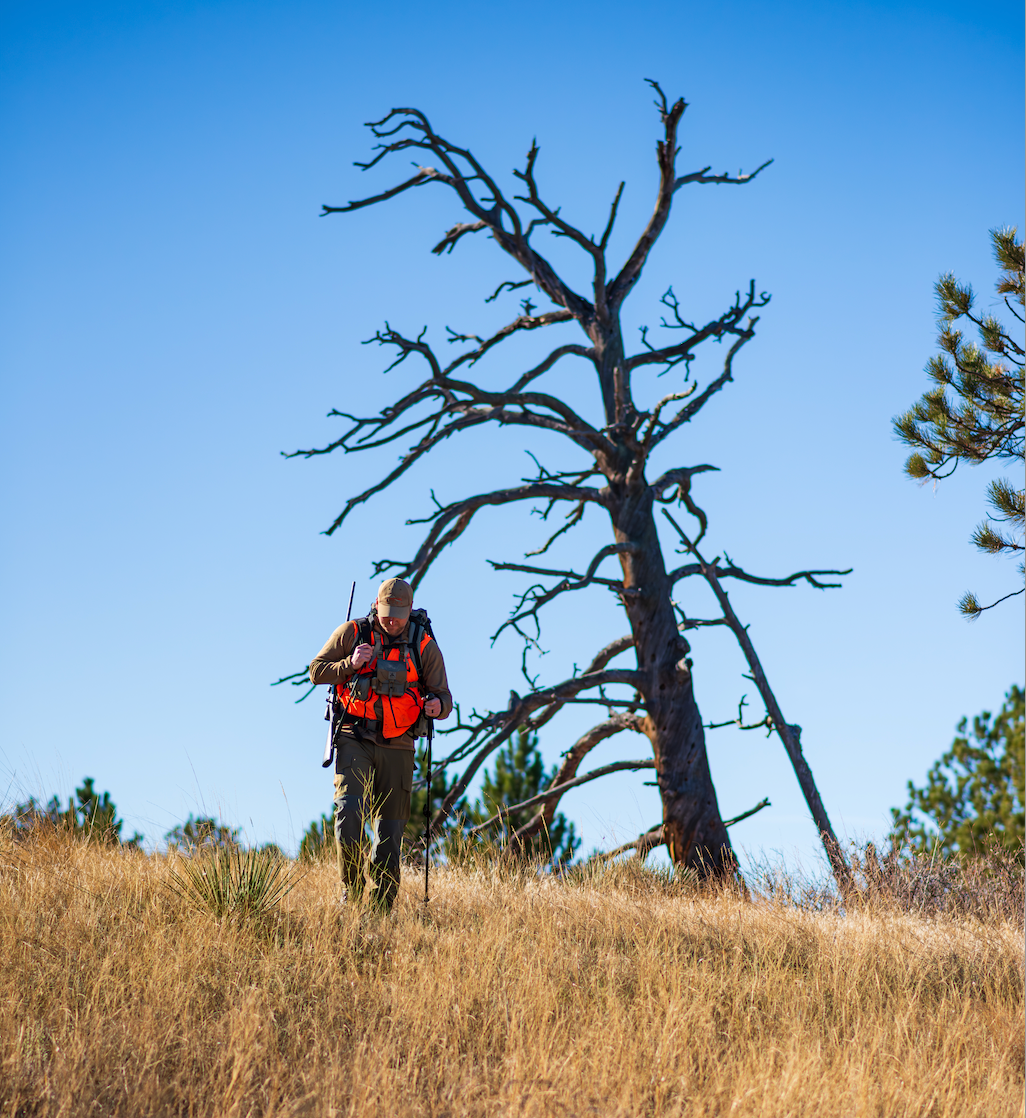
One of the most common questions we get is “Why don’t you just use a bipod?”. Bipods have earned their place in the hunting world. For long-range shooting from a stable prone position in open country, they're hard to beat. But for the kind of hunting most backcountry elk, mule deer, and antelope hunters actually do, like covering miles of steep, uneven terrain and taking shots that happen fast and rarely from the perfect position, a bipod comes with real tradeoffs that are worth understanding before you commit one to your rifle.
The Weight Problem
Even the lightest hunting bipods on the market run 10 to 16 ounces mounted to your rifle. Premium carbon fiber options from brands like Javelin or Gunwerks Elevate Ti get you down to around 10 ounces if you're lucky and willing to spend. Quality full-featured bipods like the Atlas PSR or MDT CKYE-POD run significantly heavier.
The RoadRunner Rifle Rest weighs just over one ounce.
For a day hunt or a truck-to-field setup, a pound of extra rifle weight is a non-issue. For a week-long backcountry elk hunt where every ounce in your pack and on your rifle has a cumulative effect on your endurance and your legs at the end of day five, that difference is real.
It's Always On Your Rifle
A bipod lives on your rifle whether you need it or not. That means extra bulk snagging on brush during a stalk, legs that catch on pack straps, and a permanent shift in your rifle's balance and handling characteristics. Experienced backcountry hunters know that a bipod can make a rifle feel unwieldy in tight timber and heavy brush - exactly the cover elk and deer tend to live in.
The RoadRunner Rifle Rest is on your trekking pole, not your rifle. Your rifle handles exactly the way it was designed to handle, right up until the moment you deploy the rest and take the shot. Plus, the lightweight and foldable design keeps it out of the way until you need it.
Deployment Speed
A bipod is faster to deploy than a tripod — but it still requires you to get prone or near-prone, find a flat enough surface to plant the legs, and get your body into position behind the gun. In open, flat country with time on your side, that works fine.
In backcountry hunting, shots have a tendency to happen fast. An elk steps into a clearing at 300 yards and you have seconds, not minutes. You might be on a rocky sidehill, in timber or thick brush, or mid-stalk with no time to get prone. The most common shooting scenarios in the backcountry are positions where a bipod's usefulness drops off sharply. Hunters on steep alpine terrain frequently find that bipod legs can't get level footing at all.
The RoadRunner deploys with one finger in one motion from whatever position you're already in. Sitting on a ridge glassing? Pivot the arm out and you're set. Kneeling in brush with an elk in your shooting lane? Same motion, same second. There's no prone requirement, no leg adjustment, no searching for flat ground. Deploy it, settle your gun, and you’ve got a silent and stable platform for an accurate and clean shot.
Flexibility Across Positions
This is where the real-world gap opens up. A bipod is optimized for prone shooting and loses meaningful stability as you get higher — the taller the legs, the less stable the platform. Many backcountry hunters find they carry a bipod for the entire hunt and only find it genuinely useful in a handful of specific situations.
The RoadRunner works from prone, kneeling, and sitting, adapting to whatever the terrain puts in front of you rather than requiring you to adapt to it.
When a Bipod Makes More Sense
To be fair: if you're hunting open prairie, wide-open sage flats, or glassing country where long shots from a stable prone position are the norm, a bipod is a legitimate choice. For a dedicated long-range rig where you have time to set up, find your position, and take a precision shot at extended distances, bipods do what they're designed to do very well.
But that's not most backcountry hunting. Most backcountry shots happen at moderate ranges, in imperfect conditions, in less than ideal positions, with less time than you'd like.
The Bottom Line
A bipod adds weight to your rifle, changes how it handles, and is optimized for a specific set of conditions that don't always show up in the field. The RoadRunner Rifle Rest weighs an ounce, lives on your trekking pole instead of your gun, deploys in one second from any position, and is already in your hand when the shot presents itself.
For the backcountry hunter covering real terrain and taking real shots, that's the practical choice.