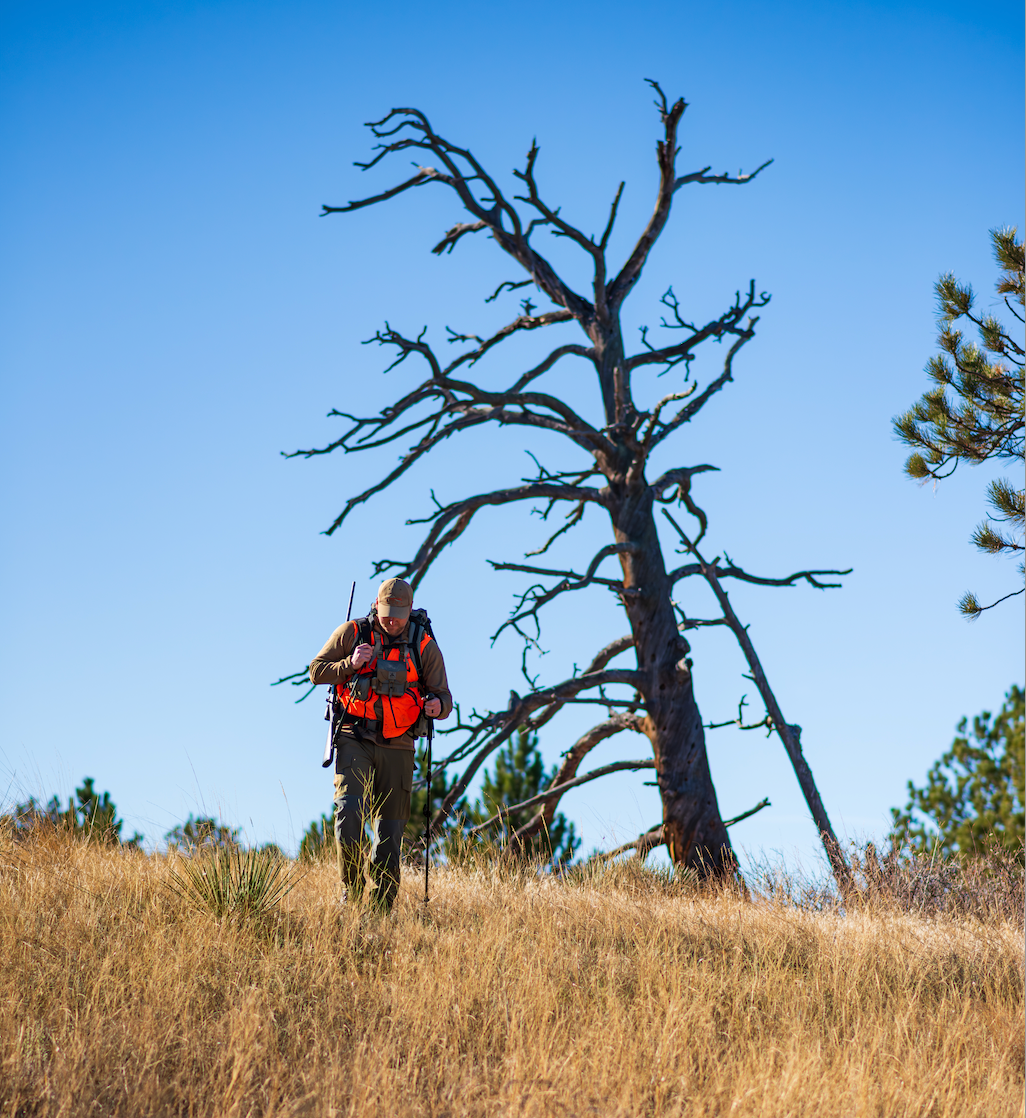
When we launched the RoadRunner Trekking Pole, the goal was simple — build a pole that pairs perfectly with the RoadRunner Rifle Rest and holds up to real backcountry hunting. It quickly became one of our best sellers. So we did what any good gear company does: we made it better.
The RoadRunner Premium Trekking Pole takes everything that worked about the standard and upgrades the materials and hardware for hunters who want the lightest, most durable setup possible. Here's what's different and how to decide which one is right for you.
The Shaft: Aluminum vs. Carbon Fiber
This is the most significant difference between the two poles, and for serious backcountry hunters, it's the one that matters most.
The standard RoadRunner Trekking Pole uses an aluminum shaft — tough, reliable, and proven across years of hard use. Aluminum handles abuse well and is a smart choice for hunters who are hard on gear or covering lower-angle terrain where weight isn't the primary concern.
The Premium upgrades to a carbon fiber shaft. Carbon fiber is stronger than aluminum at a fraction of the weight, which directly translates to less fatigue over a long day on the mountain. The Premium pole with a RoadRunner Rifle Rest mounted comes in at just 8.3 ounces — without the rest, 7.2 ounces. For a pole you're carrying all day over steep terrain, that weight savings adds up by mile five.
Carbon fiber also has natural vibration-dampening properties, which means less shock transmitted to your hands and wrists on rocky descents — a small thing that matters a lot on a weeklong backcountry hunt.
The Fasteners: Twist-Lock vs. Flip-Lock
The standard pole uses twist-lock adjustment, which is the most common locking mechanism on the market. It works well and is simple to operate.
The Premium pole uses flip-lock fasteners — the same style used on most high-end trekking poles from brands like Black Diamond and Leki. Flip-locks have a clear advantage in the field: you can see at a glance whether the lock is open or closed, they're easier to operate with gloves on, and they hold their set length more reliably under heavy load. For a hunting application where you may be adjusting pole length on the fly — shortening for a steep uphill, lengthening for a descent, or setting it for a specific shooting position — flip-locks are faster and more intuitive.
The Tips: Standard vs. Carbide
The Premium pole comes equipped with carbide tips, which are significantly harder and more durable than standard steel tips. On rocky terrain, scree fields, and hardpacked mountain soil — exactly the ground backcountry hunters cover — carbide tips bite in and hold instead of skating on the surface. They also wear far longer, so you're not replacing tips mid-season.
Which One Should You Buy?
Choose the Standard if: you're a casual weekend hunter, you're covering lower-angle terrain, you're hard on gear and want something bomber and easy to replace, or you're buying a first pole and want to try trekking poles before committing to a premium setup.
Choose the Premium if: you're covering serious backcountry miles, weight is a priority, you hunt in rocky alpine terrain, you want the best available setup for pairing with the RoadRunner Rifle Rest, or you've already used trekking poles and know what they do for your endurance and stability.
Both poles are designed from the ground up to work with the RoadRunner Rifle Rest, available as a standalone pole or bundled with one or two Rifle Rests. Whichever you choose, you're getting a pole built for the way hunters actually move through the field — not just a hiking pole with a different label.